BS 4882
Metric series bolting
NOTE 1. This section relates to metric series bolting for use with metric series pipe flanges,
valves and fittings as referred to in BS 4504 and also for general pressure containing purposes.
Dimensional requirements are given for four designs of alloy steel studbolts, three designs of alloy
steel studs and associated nuts, which use ISO metric screw threads in the following nominal
diameters (see figures 1 and 2).
| M10 | M24 | M36 | M52 | |
| M12 | M27 | M39 | M56 | |
| (M14) | M30 | M42 | M64 | |
| M16 | M33 | M45 | M70 | |
| M20 | M48 | M72 | ||
| (M22) | M76 {Studbolts only} M82 M90 M95 M100 |
|||
(Sizes M14 and M22 are non-preferred.) Metric hexagon bolts and screws (and associated nuts) may also be
used for flange bolting and in such cases selection should be made from BS 3692 or BS 4190, except that
the bearing area of bolts and nuts ordered to BS 4190 has to be full-faced to comply with this standard.
NOTE 2. BS 3692 specifies low and high tensile, medium carbon and alloy steel hexagon bolts and nuts
whereas BS 4190 specifies low tensile ‘mild steel’ hexagon bolts and nuts.
Table 5. Diameter of plain portion, maximum and minimum sizes of studbolts : metric series
| Nominal diameter | Nominal diameter design | Reduced diameter design | ||
|---|---|---|---|---|
| max. | min. 1) | max. | min. 1) | |
| mm | mm | mm | mm | |
| M10 × 1.5 | 10.0 | 9.78 | 7.49 | 7.27 |
| M12 × 1.75 | 12.0 | 11.73 | 9.07 | 8.85 |
| (M14 × 2) | 14.0 | 13.73 | 10.64 | 10.37 |
| M16 × 2 | 16.0 | 15.73 | 12.54 | 12.27 |
| M20 × 2.5 | 20.0 | 19.67 | 15.71 | 15.44 |
| (M22 × 2.5) | 22.0 | 21.67 | 17.61 | 17.34 |
| M24 × 3 | 24.0 | 23.67 | 18.86 | 18.53 |
| M27 × 3 | 27.0 | 26.67 | 21.71 | 21.38 |
| M30 × 3 | 30.0 | 29.67 | 24.56 | 24.23 |
| M33 × 3 | 33.0 | 32.61 | 27.41 | 27.08 |
| M36 × 3 | 36.0 | 35.61 | 30.26 | 29.87 |
| M39 × 3 | 39.0 | 38.61 | 33.11 | 32.72 |
| M42 × 3 | 42.0 | 41.61 | 35.96 | 35.57 |
| M45 × 4 | 45.0 | 44.61 | 37.54 | 37.15 |
| M48 × 4 | 48.0 | 47.61 | 40.38 | 39.99 |
| M52 × 4 | 52.0 | 51.54 | 44.18 | 43.79 |
| M56 × 4 | 56.0 | 55.54 | 47.98 | 47.59 |
| M64 × 4 | 64.0 | 63.54 | 55.58 | 55.12 |
| M70 × 4 | 70.0 | 69.54 | 61.38 | 60.92 |
| M72 × 4 | 72.0 | 71.54 | 63.18 | 62.72 |
| M76 × 4 | 76.0 | 75.54 | 67.08 | 66.62 |
| M82 × 4 | 82.0 | 81.46 | 72.28 | 72.24 |
| M90 × 4 | 90.0 | 89.46 | 80.38 | 79.84 |
| M95 × 4 | 95.0 | 94.46 | 85.11 | 84.57 |
| M100 × 4 | 100.0 | 99.46 | 89.86 | 89.32 |
|
1) Based on tolerance class h13 of BS 4500 |
||||
Studbolts
2.1.1. General
The forms of the studbolts shall comply with those shown in figure
1(a),(b),(c) or (d).Dimensions shall be as given in 2.1.2 to 2.1.8 and tables 5 to 8
Table 6. Tolerance on nominal length of studbolts: metric series
| Nominal diameter | Length | Tolerance on length |
|---|---|---|
| mm | mm | |
| ≤ M24 | ≤ 150 | ± 0.75 |
| > 150 | ± 1.00 | |
| > M24 ≤ M48 | ≤ 180 | ± 1.00 |
| > 180 | ± 1.5 | |
| > M48 ≤ M100 | All | ± 2.00 |
Table 7. Preferred nominal lengths of studbolts:metric series (based on flange designs as specified in BS 4504)
| Nominal diameter | Preferred lengths | |||||||||||||||||||||||||||||||||
|---|---|---|---|---|---|---|---|---|---|---|---|---|---|---|---|---|---|---|---|---|---|---|---|---|---|---|---|---|---|---|---|---|---|---|
| 40 | 45 | 50 | 55 | 60 | 65 | 70 | 75 | 80 | 85 | 90 | 95 | 100 | 105 | 110 | 115 | 120 | 125 | 130 | 140 | 150 | 160 | 170 | 180 | 190 | 200 | 220 | 240 | 260 | 280 | 300 | 340 | 360 | 380 | |
| M10 | ||||||||||||||||||||||||||||||||||
| M12 | X | X | X | X | X | X | X | |||||||||||||||||||||||||||
| (M14) 1) | ||||||||||||||||||||||||||||||||||
| M16 | X | X | X | X | X | |||||||||||||||||||||||||||||
| M20 | X | X | X | X | X | X | ||||||||||||||||||||||||||||
| (M22) 1) | ||||||||||||||||||||||||||||||||||
| M24 | X | X | X | X | X | X | X | X | ||||||||||||||||||||||||||
| M27 | X | X | X | X | X | X | X | X | X | X | ||||||||||||||||||||||||
| M30 | X | X | X | X | X | X | X | X | X | X | X | X | X | X | X | X | ||||||||||||||||||
| M33 | X | X | X | X | X | X | X | X | X | X | X | X | X | |||||||||||||||||||||
| M36 | X | X | X | X | X | X | X | X | X | X | X | X | ||||||||||||||||||||||
| M39 | X | X | X | X | X | X | X | X | X | X | X | X | ||||||||||||||||||||||
| M42 1) | ||||||||||||||||||||||||||||||||||
| M45 | X | X | X | X | X | X | X | X | X | X | X | X | ||||||||||||||||||||||
| M48 | X | |||||||||||||||||||||||||||||||||
| M52 | X | X | X | X | X | X | ||||||||||||||||||||||||||||
| M56 | X | X | X | X | X | |||||||||||||||||||||||||||||
| M64 | X | X | X | X | ||||||||||||||||||||||||||||||
| M70 1) | ||||||||||||||||||||||||||||||||||
| M72 | X | |||||||||||||||||||||||||||||||||
| M76 1) | ||||||||||||||||||||||||||||||||||
| M82 1) | ||||||||||||||||||||||||||||||||||
| M90 1) | ||||||||||||||||||||||||||||||||||
| M95 1) | ||||||||||||||||||||||||||||||||||
| M100 1) | ||||||||||||||||||||||||||||||||||
|
Preferred nominal lengths to be completed in a later revision of this standard. |
||||||||||||||||||||||||||||||||||
Table 7. Length of point (see 2.2.6) for studbolts: metric series
| Nominal diameter | Length |
|---|---|
| mm | |
| M10 | 1.17 |
| M12 | 1.32 |
| (M14) | 1.48 |
| M16 | 1.48 |
| M20 | 1.80 |
| (M22) | 1.80 |
| M24 | 2.09 |
| M27 | 2.09 |
| M30 | 2.09 |
| M33 | 2.09 |
| M36 | 2.09 |
| M39 | 2.09 |
| M42 | 2.09 |
| M45 | 2.70 |
| M48 | 2.70 |
| M52 | 2.70 |
| M56 | 2.70 |
| M64 | 2.70 |
| M70 | 2.70 |
| M72 | 2.70 |
| M76 | 2.70 |
| M82 | 2.70 |
| M90 | 2.70 |
| M95 | 2.70 |
| M100 | 2.70 |
Nominal length
The tolerances on nominal length shall be as given in table 6.
NOTE 1. The preferred nominal lengths are given in table 7. If lengths other than these are requested (see
appendix C) the increments of length should be as given in table 9.
NOTE 2. Length of point is included in nominal length (see 1.2.2.1).
Table 9. Increments of nominal length of studbolts: metric series
| Nominal length | Increment | |
|---|---|---|
| Over | Up to and including | |
| mm | mm | mm |
| -- | 65 | 5 |
| 65 | 200 | 10 |
| 200 | 300 | 20 |
| 300 | -- | 25 |
2.1.3 Length of thread
For studbolts having plain portions as shown in figures 1(b),1(c) and 1(d), the basic length of thread
shall be the nominal diameter plus 10 mm.
For studbolts as in figures 1(b) and 1(c), the tolerances on the length of thread shall be plus 2
pitches, minus 0.
2.1.4 Length of reduced diameter portion
The basic length of the reduced diameter portion shall be 0.6 times the nominal diameter (see figure 1(d)
and item (d)(5) of appendix C.
The following tolerances shall apply to this dimension:
(a) +0.75, −0 mm for lengths up to and including 28 mm;
(b) +1.50, −0 mm for lengths over 28 mm.
2.1.5 Length of thread plus length of reduced diameter portion
The following tolerances shall apply to this dimension:
(a) ±1.0 mm for nominal diameters up to and including M48;
(b) ±2.0 mm for nominal diameters over M48 and up to and including M100.
2.1.6 Ends
The ends of studbolts shall be finished with a point having an included angle of approximately 90° to a depth slightly exceeding the depth of thread. Nominal lengths of points for reference purposes shall be as given in table 8.
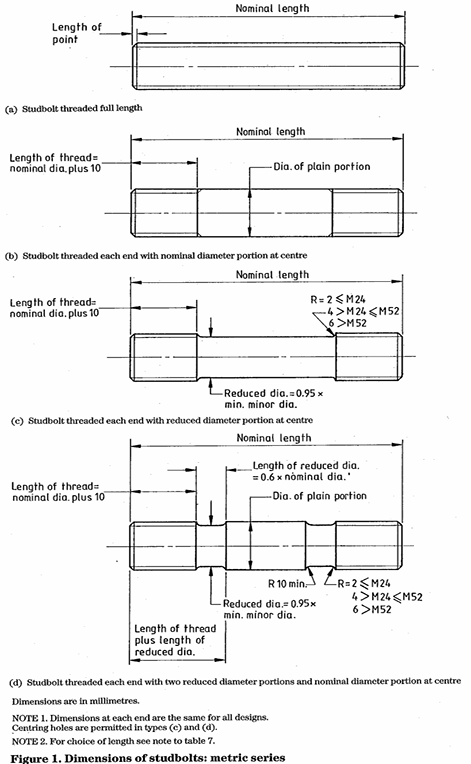
2.1.7 Diameter of plain portion
The diameter of the plain portion shall not exceed the maximum values given in table 5.
NOTE. The diameter of the reduced portion should be stated by the purchaser in the order (see appendix
C).Under normal conditions a minimum of 0.95 times the minor thread diameter is used, but for studs
subject to particularly onerous conditions (such as high temperature service) diameters less than this may
be used.
2.1.8 Screw threads
Screw threads for studbolts for all materials other than mild or carbon steel shall comply with requirements given in table 10.
Table 10. Pitch of screw threads for studbolts: metric series
| Nominal diameter | Pitch |
|---|---|
| ≤ M27 | ISO metric coarse (see BS 3643) |
| ≥ M30 ≤ M43 | 3mm |
| ≥ M45 ≤ M100 | 4mm |
The ISO metric coarse pitch series shall be used throughout the range of sizes for mild or carbon steel.
NOTE. The tolerance class should be stated by the purchaser in the order (see appendix
C), but for most conditions the following are applicable:
(a) class 6g for carbon steel and grades MB7, ML7, MB7A, MB16, MB16A, MB16B;
(b) class 6e for other materials.
2.2 Studs
2.2.1 General
The forms of the studs shall comply with those in figure 2(a), (b) or (c). Studs shown in figure 2(a) shall comply with BS 4439, covering sizes up to M39 and shall have ISO coarse pitches. Studs to figures 2(b) and 2(c) shall have pitches in accordance with 2.2.10.
The dimensions of studs to figure 2(b) or 2(c) shall be as given in 2.2.2 to 2.2.11 and tables 5, 6 and 8 for studbolts.
2.2.2 Nominal length
The nominal lengths shall be in increments of 5 mm.
NOTE. The length of point is included in nominal length (see 1.2). The tolerances on nominal length shall be as given in table 6.
2.2.3 Length of metal end of thread
For studs as shown in figures 2(b) and 2(c), the length of full form thread at the metal end shall equal nominal diameter except where high strength studs are used with weak flange materials, in which case the metal end threaded length shall be equal to 1.5 times the nominal diameter.
2.2.4 Length of nut end of thread
For studs as shown in figures 2(b) and 2(c), the basic length of thread shall be as given in table 11.
Table 11. Length of thread for studs : metric series
| Nominal diameter | Thread length |
|---|---|
| mm | |
| ≤ M12 | Nominal dia. + 4 |
| > M12 ≤ M20 | Nominal dia. + 6 |
| > M20 ≤ M72 | Nominal dia. + 10 |
2.2.5 Length of reduced diameter portion
The basic length of the reduced diameter portion shall be 0.6 times the nominal diameter (see figure
2(b)), and shall be rounded up to the next whole millimetre.
The following tolerances shall apply to this dimension:
(a) +0.75, −0 mm for lengths up to and including 28 mm;
(b) +1.50, −0 mm for lengths over 28 mm.
2.2.6 Lengths of thread plus length of reduced diameter portion
The following tolerances shall apply to this dimension:
(a) ± 1.0 mm for nominal diameters up to and including M48;
(b) ± 2.0 mm for nominal diameters over M48 and up to and including M72.
2.2.7 Ends
The nut ends shall be finished with a point having an included angle of approximately 90° to a depth slightly exceeding the depth of thread. Lengths of points shall be as given in table 8.
The metal ends shall be finished as follows:(a) for studs as illustrated in figure 2(b) the corner shall be broken at 45° to give a smooth edge;
(b) for studs as illustrated in figure 2(c) the end dimensions shall comply with the scale of sizes given in table 12.
Table 12. Stud dimensions: metric series
| Nominal diameter | Ring contact diameter | Ring diameter radius | Length of plain ring portion |
|---|---|---|---|
| mm | mm | mm | |
| M10 to M12 | Nominal dia. -5 | 1 | 5 |
| M14 to M27 | Nominal dia. -6 | 1.5 | 6 |
| M30 to M72 | Nominal dia. -8 | 2 | 8 |
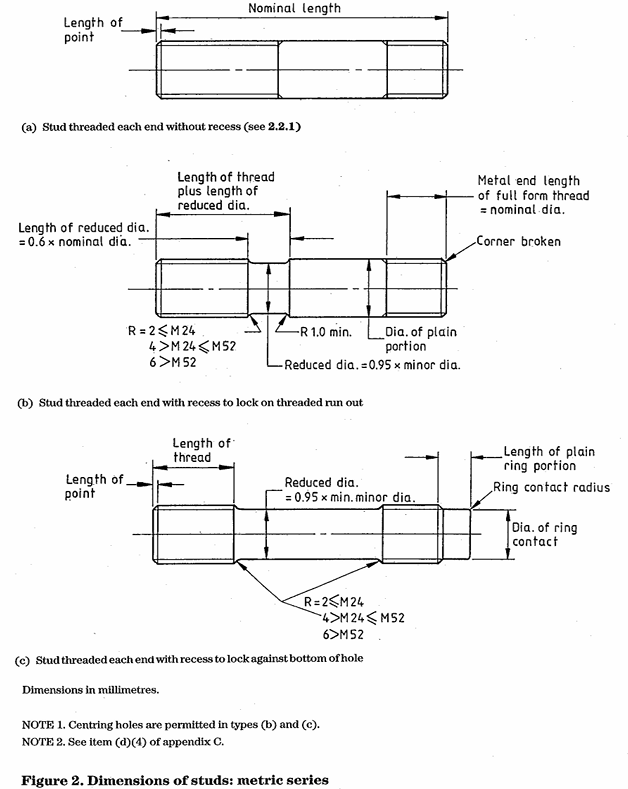
2.2.8 Diameter of plain portion
The diameter of the plain portion shall be to the maximum and minimum sizes shown in table 5.
2.2.9 Diameter of reduced portion
The diameter of the reduced portion shall not exceed the maximum values given in table 5.
NOTE: The diameter of the reduced portion should be stated by the purchaser in the order (see appendix C). Under normal conditions a minimum of 0.95 times the minor thread diameter is used, but for studs subject to particularly onerous conditions (such as high temperature service) diameters less than this may be used.
2.2.10 Screw threads
Screw threads for studs of all materials other than low and medium carbon steel shall comply with the requirements given in table 13.
Table 13. Pitch of screw threads for studs: metric series
| Nominal diameter | Pitch |
|---|---|
| ≤ M27 | ISO metric coarse (see BS 3643) |
| > M30 ≤ M42 | 3 mm |
| > M45 ≤ M72 | 4 mm |
NOTE 1: For low and medium carbon steel, it is permissible to use the ISO metric coarse pitch series throughout the range of sizes for low and medium carbon steel.
NOTE 2: The tolerance class (see BS 3643) should be stated by the purchaser in the order (see appendix C), but for most conditions the following are applicable:
- The metal end of studs should be tolerance class 4h for all materials;
- The nut end of studs should be to the following classes:
- Class 6g for carbon steel and grades MB7, ML7, MB7A, MB16, MB16A, MB16B;
- Class 6e for other materials.
2.2.11 Tolerances on nominal length
The tolerances on nominal length shall be as shown in table 6.
2.3 Nuts for use with metric series bolts and studs
2.3.1 Dimensions
Nuts shall comply with the dimensions and tolerances given in table 14.
Table 14. Dimensions of hexagon nuts: metric series
| Nominal size and pitch | Width across flats s | Width across corners e | Thickness m | Tolerance on squareness | ||
|---|---|---|---|---|---|---|
| max. | min. | min. | max. | min. | ||
| mm | mm | mm | mm | mm | mm | |
| M10 × 1.5 | 16.00 | 15.57 | 17.59 | 8 | 7.42 | 0.29 |
| M12 × 1.75 | 18.00 | 17.57 | 19.85 | 10 | 9.42 | 0.32 |
| (M14 × 2) | 21.00 | 20.16 | 22.78 | 11 | 10.30 | 0.37 |
| M16 × 2 | 24.00 | 23.16 | 26.17 | 13 | 12.30 | 0.41 |
| M20 × 2.5 | 30.00 | 29.16 | 32.95 | 16 | 15.30 | 0.51 |
| (M22 × 2.5) | 34.00 | 33.00 | 37.29 | 18 | 17.30 | 0.54 |
| M24 × 3 | 36.00 | 35.00 | 39.55 | 19 | 18.16 | 0.61 |
| M27 × 3 | 41.00 | 40.00 | 45.20 | 22 | 21.16 | 0.70 |
| M30 × 3 | 46.00 | 45.00 | 50.85 | 24 | 23.16 | 0.78 |
| M33 × 3 | 50.00 | 49.00 | 55.37 | 26 | 25.16 | 0.85 |
| M36 × 3 | 55.00 | 53.80 | 60.79 | 29 | 28.16 | 0.94 |
| M39 × 3 | 60.00 | 58.80 | 66.44 | 31 | 30.00 | 1.03 |
| M42 × 3 | 65.00 | 63.80 | 72.09 | 34 | 33.00 | 1.11 |
| M45 × 4 | 70.00 | 68.80 | 77.74 | 36 | 35.00 | 1.20 |
| M48 × 4 | 75.00 | 73.80 | 83.39 | 38 | 37.00 | 1.29 |
| M52 × 4 | 80.00 | 78.80 | 89.04 | 42 | 41.00 | 1.37 |
| M56 × 4 | 85.00 | 83.60 | 94.47 | 45 | 44.00 | 1.46 |
| M64 × 4 | 95.00 | 93.60 | 105.77 | 51 | 49.80 | 1.63 |
| M70 × 4 | 100.00 | 98.60 | 114.42 | 56 | 54.80 | 1.76 |
| M72 × 4 | 105.00 | 103.60 | 117.07 | 58 | 56.80 | 1.81 |
| M76 × 4 | 110.00 | 108.60 | 122.72 | 61 | 59.80 | 1.89 |
| M82 × 4 | 120.00 | 118.60 | 134.01 | 66 | 64.80 | 2.02 |
| M90 × 4 | 130.00 | 128.60 | 145.32 | 72 | 70.80 | 2.20 |
| M95 × 4 | 135.00 | 133.60 | 150.97 | 76 | 74.80 | 2.31 |
| M100 × 4 | 145.00 | 143.60 | 162.27 | 80 | 78.80 | 2.42 |
|
NOTE. The dimensions are illustrated in figure 3. |
||||||
2.3.2 Faces
Nuts shall have a chamfer of approximately 30° on the non-bearing face only. The bearing face shall be full faced. The bearing face shall be machined, or have a surface equal to that produced by machining.
The faces of the nut shall be square to the axis of the thread of the nut within the tolerances given in table 14 (see figure 3 and appendix E).
2.3.3 Screw threads
Screw threads for all materials other than low and medium carbon steel shall comply with the requirements given in table 15.
Table 15. Pitch of screw threads for nuts: metric series
| Nominal dia. | Pitch | Note |
|---|---|---|
| ≤ M27 | ISO metric coarse (see BS 3643) | Class 6H (see item (d)(6) of appendix C) |
| ≥ M30 ≤ M42 | 3 mm | |
| ≥ M45 ≤ M100 | 4 mm |
The ISO metric coarse pitch series shall be used throughout the range of sizes for low and medium carbon steel.
The screw threads in nuts shall be concentric with the hexagons within a tolerance of 2 IT13, FIM (see BS 6322 : Part 1), using the width across flats as reference datum.
